
Slovenia’s Updated Dietary Guidelines Put Health and Sustainability on the Same Plate
Dr Roberta Alessandrini, PAN’s Director of the Dietary Guidelines Initiative, weighs in on why this update matters for healthcare professionals and the future of evidence-based nutrition.
Slovenia has officially updated its national food-based dietary guidelines with the publication of Prehrana za zdravje in planet, a new set of recommendations connecting nutrition, health and planetary sustainability.
Published on 22 May 2026, the guidelines were commissioned by the Ministry of Health and developed by a multidisciplinary panel of experts. Drawing on World Health Organization (WHO) and EAT-Lancet frameworks, they bring together evidence on nutrition, chronic disease prevention, environmental sustainability and national food habits, offering practical guidance for individuals, healthcare professionals, educators and those involved in institutional food planning.
For healthcare professionals, nutrition educators and public health practitioners, the update is especially relevant because it moves dietary guidance beyond general advice and towards clearer, more practical recommendations that can support counselling, education and institutional meal planning.
A more inclusive approach to healthy eating
One of the most notable features of the updated guidelines is that they recognise more than one healthy dietary pattern.
Rather than presenting a single model, the guidelines provide practical plate-based examples for Mediterranean-style, lacto-ovo vegetarian and whole-food plant-based dietary patterns, with the main differences reflected in the protein section of the plate. This is useful because patients and communities do not all eat in the same way. Dietary advice needs to be flexible enough to reflect different preferences, needs and values, while still supporting nutritional adequacy and long-term health.
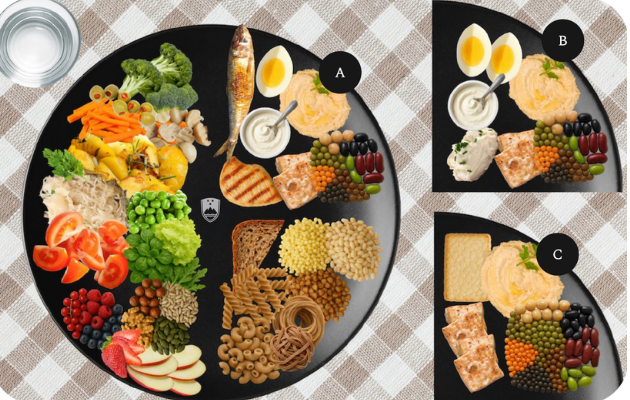
Plate-based examples in Slovenia’s updated dietary guidelines: a) Mediterranean-style, b) lacto-ovo vegetarian, c) whole-food plant-based.
By recognising different dietary patterns within one national framework, the guidelines give healthcare professionals and educators a more flexible tool for supporting healthier food choices in real-world settings.
Clearer guidance on key food groups
The updated framework also places stronger emphasis on measurable food group targets.
This is important because broad advice to “eat healthier” can be difficult to translate into daily choices. More specific targets can help healthcare professionals, nutrition educators and food service providers translate nutrition advice into practical action.
Meat and animal proteins: supporting a shift toward healthier protein choices
To support healthier dietary patterns and reduce risk factors associated with cardiovascular disease and metabolic health, the guidelines establish a clear upper limit on meat intake.
The recommendation sets total meat intake at a maximum of 300 grams per week. Within this allocation, red meat is limited, with preference given to smaller portions of lean poultry or sustainably sourced fish where applicable, alongside a greater emphasis on plant-based protein sources.
The guidelines also advise minimising or avoiding ultra-processed foods, free sugars and processed meats, reflecting a broader shift toward whole and minimally processed foods.
For healthcare professionals, this provides a clearer basis for conversations about gradual, achievable dietary change. The message is not simply to remove foods, but to help people build meals around healthier protein sources and more whole-plant foods.
Pulses and legumes: a stronger role for plant protein
To support the reduction in animal protein, pulses are elevated to a primary food group with clear daily benchmarks.
The guidelines recommend a minimum intake of 50 g dry legumes per day, equivalent to 100–150 g of cooked legumes or roughly one to two standard servings of beans, lentils or chickpeas. They also recommend a daily intake of soy foods, 70 g, such as tofu or unsweetened soy-based drinks.
This recommendation supports a steady intake of plant protein, complex carbohydrates and important minerals such as iron and zinc, while contributing meaningfully toward the recommended 15 to 25 g of daily dietary fibre for individuals aged two and older.
This is a positive development because legumes can support healthier dietary patterns in a practical and affordable way. They are versatile, widely adaptable across different cuisines, and can be used in everyday meals as alternatives to some meat-based dishes.
Whole grains: everyday staples for healthier meals
Whole grains are another key focus of the updated guidance.
The guidelines recommend consuming at least four portions of grains per day, approximately 230 g raw or 600 g cooked, with at least half coming from whole grains. This involves replacing refined starches with whole grains such as oats, brown rice, buckwheat and whole wheat. The recommendation also encourages a gradual increase in whole grain consumption, starting with the target of making at least half of the grain intake whole grain.
These foods form an important foundation for meals and can support long-term glycaemic control, digestive health and overall dietary quality. In clinical and educational settings, whole grains can be positioned as practical everyday staples rather than specialist “health foods”, which makes the guidance easier to translate into routine patient conversations and institutional meal planning.
Alternative plant proteins: practical options for lower-meat and plant-based diets
The guidelines also recognise that shifting to a lower-meat or entirely plant-based dietary pattern requires practical, nutrient-dense alternatives.
For the first time, processed and fermented soy products are officially integrated into national dietary recommendations. The guidelines explicitly endorse tofu, tempeh and fortified soy-based drinks as valuable, high-protein options across the various plate models proposed. These foods are recommended for everyone, but represent an important protein source, particularly for vegetarian and vegan dietary patterns.
Healthcare professionals can recommend these foods as practical alternatives because they offer complete amino acid profiles, lower saturated fat content compared with many animal-based options, and, in the case of calcium-set tofu and fortified soy milk, highly bioavailable calcium.
The document also notes the added value of fermented options such as tempeh, which may support gut health alongside fibre intake.
Inclusion of Broader Healthy Living Principles
Beyond specific eating habits, the guidelines also include foundational healthy living principles to support overall well-being. These include aiming for at least 7 hours of quality sleep per day, maintaining regular face-to-face social connections, actively managing stress, and performing strength training exercises at least twice a week alongside daily movement, such as walking or taking the stairs.
Why this matters for healthcare professionals
Nutrition is a major part of chronic disease prevention and long-term health, yet many healthcare professionals have limited time and training to translate dietary evidence into practical advice.
Slovenia’s updated guidelines offer a useful example of how national dietary guidance can become more actionable. By combining health, sustainability and clearer food group targets, they can support clinical conversations, public health education and institutional food planning.
This is especially relevant in settings such as schools, hospitals, universities and public institutions, where food choices are shaped not only by individual behaviour, but also by the meals and options made available.
For healthcare professionals, the guidelines provide a practical basis for helping people move towards dietary patterns that are more plant-forward, nutrient-rich and sustainable, while still allowing for flexibility and individual context.
A step forward for nutrition and planetary health
The updated Slovenian guidelines reflect a growing recognition that dietary guidance cannot be separated from the wider food system. What people eat affects health outcomes, but it also affects environmental sustainability. The guidelines, in fact, include the environmental impact of food groups expressed in greenhouse gas equivalents to guide the general population, as well as clinicians to understand more about the broader environmental impact of dietary patterns. By bringing these connections into national dietary guidance, Slovenia has taken an important step toward aligning nutrition advice with both human and planetary health.
For PAN International, this is a meaningful development. It reinforces the importance of bringing evidence-based nutrition into healthcare and highlights the role health professionals can play in translating national dietary guidance into practical, everyday choices.
As more countries update their food-based dietary guidelines, Slovenia’s approach offers a valuable example of how national recommendations can support healthier people, healthier food environments and a healthier planet. It also shows how dietary guidance can give health professionals clearer tools for action.